
When Daniel Pelaez took a job with the Town of Southbury, Connecticut Public Works Department after his first year at Worcester Polytechnic Institute, he learned lessons that, a few years later, would become the basis for his startup, Cyvl. Daniel spent a season on the public works road crew fixing issues flagged by residents or found by the road foreman. He asked the public works director how they kept track of road conditions, and the director explained that they conventionally paid civil engineering consultants to capture the data by hand by walking and driving the streets with clipboards.
"That was my first eye-opening experience of seeing firsthand just how hard it is for our local governments to manage these very large-scale physical infrastructure assets, such as their roads, their sidewalks, their trees, their signage," said Pelaez. And he notes, infrastructure maintenance is often the largest line item in a local government's budget. "They were paying these people to walk the roads every few years and manually inventory every single crack. It's just not scalable. It's impossible to manage our roads that way."
Pelaez did not act upon his insights immediately; his thoughts about public works would have to wait a few more years to evolve into a commercializable idea and for him to tap into MassVentures, Massachusetts's quasi-public venture capital agency that would help turn his insights into a successful company.
Pelaez returned to WPI, where he was learning about self-driving cars and robotics. There, he and two of his WPI classmates got together to prototype an off-the-shelf sensor system for placement on the back of garbage trucks. They took the images created by the sensors and fed them into a machine learning platform, which would determine which potholes needed fixing. Then, under the guidance of WPI’s NSF I-Corps program, they visited 30 towns to find out if their data—and their advice about what actions to take based on that data—would be of value to public works departments. The answer, said Pelaez, was "a resounding 'yes.'”
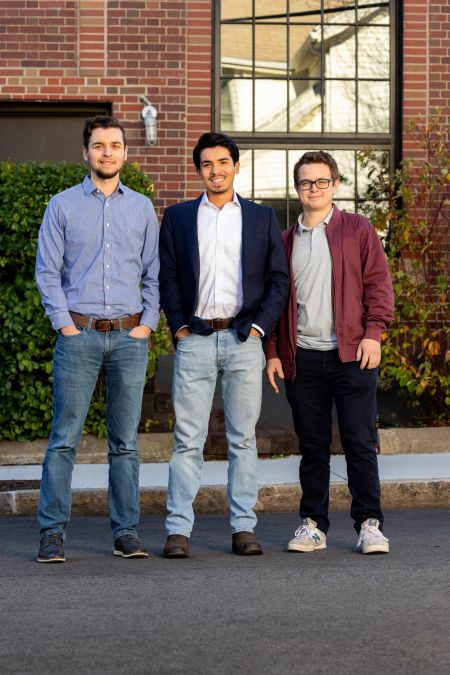
Cyvl cofounders (L to R)
Noah Budris, Daniel Pelaez, and Noah Parker
After graduation, the group won a few pitch competitions with their prototype, but they competed "just for fun" and had "day jobs" elsewhere. They got their first round of funding through angel investors in the WPI network, who advised them to quit their jobs and work on their company full-time. MassVentures entered the picture around this time.
MassVentures knew that finding investors for this company would be challenging. “In most venture ecosystems, many institutional venture capital firms will publicly say they only invest in serial entrepreneurs,” said MassVentures President and CEO Charlie Hipwood. “That's because there's a lot of operational risk that goes along with doing a startup.” This founding team was comprised of first-time founders with very little work experience. Also, their appeal to investors was challenging because they were selling GovTech, which was perceived as having a long, complex sales process. "This is a company that likely otherwise, without support from MassVentures, would not have gotten institutional funding for many years," said Hipwood.
Despite these challenges, MassVentures threw its support behind them. "We worked with Daniel and his cofounders for about a year, helping them refine their pitch, helping them think through the steps they needed to take to be attractive to private capital," said Hipwood. “We try to be as helpful as we can without getting in the way. We believe that delivering well-prepared founders to private capital is important.”
After a year of mentoring from MassVentures, Cyvl was ready to find investors. But the timing—fall, 2022—wasn't optimal. Hipwood noted:
That's when the markets began to shift a bit, making it harder to raise venture capital. And so, given the market timing, we also spent a lot of time working with the team on what kind of financing made sense to attract the right type of investors: what pricing made sense, what structure made sense, what option pool made sense. So, we spent a lot of time on a financing strategy to make sure we weren't coming out with too high a valuation that might scare off investors, and not too low of a valuation where people didn't think there was much substance at that point. And making sure we were setting up the company to be successful for future capital raises as well.
"We led a term sheet, because Cyvl had some people interested around the periphery, but nobody was interested in leading, writing the large check, and being on the board of directors," said Hipwood.
The funding they used for issuing the term sheet and closing the first few rounds came from the SSBCI program; Cyvl was the first company for which they used that funding source. Hipwood noted that using the funds from the SSBCI program at a time when the venture community pulled back was a good use of federal funds intended to support equity investments in startups.
MassVentures’ Vice President of Investments Priya Yadav noted another way in which they helped Cyvl attract investors: as a known entity within the startup ecosystem, MassVentures lent credibility to Cyvl. "It's been much easier for this company to bring on other investors because we were there, and we were always at the forefront, trying to issue term sheets when we could so that we could bring in other investors faster," she said.
MassVentures' work with Cyvl is typical of its work with the handful of new, deep-tech companies it funds each year. "We're meant to fill capital gaps in the Massachusetts ecosystem," said Hipwood. "And one of those capital gaps is funding for first-time founders. We help them get some non-dilutive funding, if possible, from the state or federal government, introducing them to potential customers, employees, and others, ultimately delivering well-prepared founders to customers and private capital."
The funding Cyvl received from government sources, such as the I-Corps and SSBCI programs, and from private investors, has been put to good use. Hipwood notes that, regarding the SSBCI funds, "They helped create a business and jobs that likely otherwise would not have been created. And they were solving problems that are directly impacting the budgets of local municipalities and towns. They were helping them reduce their operating budgets by being more strategic about which roads to fix, which sidewalks to fix, which trees need to come down or need pruning, in a much more efficient manner."
Pelaez has received reports from his clients that Cyvl's services save them at least 5-10% on their public works projects. His company works with 300 towns or cities nationwide; 70 of those are in Massachusetts. The combined infrastructure investments have amounted to $7-10 billion.
"The impact we see at scale is how we make their budget dollars go further, be more efficient, and also create more transparency to the taxpayers who ultimately are funding these large roadway projects," said Pelaez. He has heard "time and time again" that cities and towns working with Cyvl were able to pave four times more than the number of roads they would typically do in a season. “Cyvl's analytics, suggestions, and planning,” he said, make the taxpayers' dollars go even further.
Pelaez expects that by the end of 2026, one in three Americans will be driving on roads managed by Cyvl's software. Already, in 2025, more than half of Massachusetts' population lives in areas where Cyvl has analyzed infrastructure, according to Pelaez.
As he improves his software, Pelaez expects that the positive impact will grow significantly. "We build more solutions on top of the data we're collecting," he said. "Our goal is for people to be able to build roads 15-20% faster and for less dollars, getting more done for less and getting it done faster."
Cyvl’s success represents only one of the almost 200 companies MassVentures has funded since it was created in 1978. MassVentures funds companies primarily through their venture capital fund, which was created from $8.5 million it received from the Commonwealth of Massachusetts in 1978. Since then, through its support of startups, it has generated an annual average of $1.9 billion in total Massachusetts’ GDP, $3.3 billion in economic activity, and $119 million in state and local tax revenues. In addition, MassVentures’ investments have directly supported an average of 4,346 jobs each year.
Cyvl has taken off, and investors are supporting them. The first tranche of their Series A1 closed in August 2025, and their second tranche, with new institutional investors, closed in September 2025.
MassVentures remains engaged with the company. Yadav served on their board when MassVentures led their first term sheet, transitioned over time to a voting board member, and is now a board observer. Yadav noted that MassVentures continues to encourage them to submit proposals for non-dilutive funding. "We've been pointing them to state-level and federal-level funding opportunities. They've been applying and getting great opportunities."
“We hit it off well with MassVentures,” said Pelaez. “They led the investment in our first official venture round. We raised just shy of $3 million. That was back in 2022. They've invested in two additional rounds since then. They've been super supportive of us and awesome to work with.”
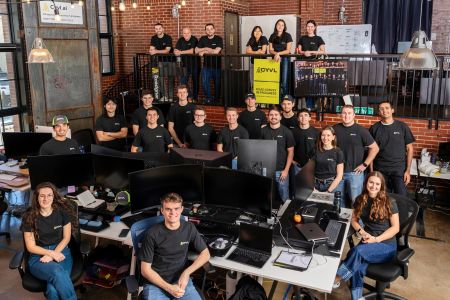
The Cyvl team is now 20+ strong!