
Skip to main content
State Science & Technology Institute (SSTI) logo

Secondary Menu

  • Events
    • Educational Opportunities
    • Annual Conference
    • Webinars
    • Past Events
  • Advocacy
    • Innovation Advocacy Council
    • Policy Statements
  • Job Corner
  • Sign In
  • Search

Main menu

  • About SSTI
    • Mission
    • Board
    • Team
    • Contact Us
    • TBED Community of Practice
  • Membership
    • Why Join
    • Join/Renew
    • Member List
  • Resources
    • Digest Articles
    • Useful Stats
    • Recent Research
    • Webinar Library
  • Funding
    • Funding Supplement
    • Federal Funding Video library
  • Join SSTI
  • Sign up for SSTI Digest

Search

Displaying 326 - 350 of 390
Authored on

HHS Releases $1 Billion Biotech Research Tax Credit Guidelines

Wednesday, May 26, 2010

The Department of Health and Human Services, with the Department of Treasury, has released detailed guidelines for biotechnology companies interested in applying for the research tax credit introduced in the Health Care bill earlier this year. The Qualifying Therapeutic Discovery Project Credit provides a 50 percent income tax credit for investments in certified research projects made in 2009 and 2010. A total of $1 billion in credits will be available. Applications for certification must be submitted to the Internal Revenue Service (IRS) by July 21 for the primary allocation round.
  • Read more about HHS Releases $1 Billion Biotech Research Tax Credit Guidelines

Useful Stats: Federal Obligations for R&D to Industry by State FY2001-07

Wednesday, May 26, 2010

The State of Washington led the country in 2007 in federal funding for industrial research and development (R&D), receiving $3.27 billion, according to the latest numbers from the National Science Foundation (NSF). While 42.3 percent of total federal R&D funding supported industrial R&D, 69.5 percent of federal funding in Washington went to private companies. Arizona, Maine, Connecticut, Nevada and Texas all received more than 65 percent of their federal R&D dollars in industrial support.

  • Read more about Useful Stats: Federal Obligations for R&D to Industry by State FY2001-07

AZ Gov Signs R&D Tax Credit Bill Expanding Access to Capital

Wednesday, May 19, 2010

Gov. Jan Brewer last week signed a measure modifying Arizona's existing R&D tax credit legislation to allow for small businesses to collect discounted refunds on R&D tax credits already earned. The measure is hailed as an important tool for providing small, tech-based companies with access to capital. Read the Arizona Technology Council press release ...

  • Read more about AZ Gov Signs R&D Tax Credit Bill Expanding Access to Capital

Federal Funding for Basic Research Increasing, NSF Says

Wednesday, May 12, 2010

A recent report from the National Science Foundation (NSF) shows that funding for general science and basic research grew by 17.5 percent between 2008 and 2010. The report divides federal R&D funding into 20 categories defined by their function. Basic research comprises 7.2 percent of the proposed FY10 budget, up from 6.2 percent in the actual FY08 budget. Meanwhile, national defense, the leading target of federal R&D funding, dropped from 59 percent of total funding to 57 percent. Read the report ...

  • Read more about Federal Funding for Basic Research Increasing, NSF Says

Health Care Bill Includes 50 Percent Credit for Biotech Research

Wednesday, May 5, 2010

During the debates over the Patient Protection and Affordable Care Act, also known as the Health Care Reform Bill, there was much discussion of whether or not reform would hinder innovation in pharmaceuticals and medicine. As a result, the final legislation included some measures to support research and commercialization in the life science. One such measure, the Therapeutic Discovery Project Credit, offers a 50 percent tax credit or cash grant for qualifying research projects and small- and medium-sized companies.

  • Read more about Health Care Bill Includes 50 Percent Credit for Biotech Research

White House Extends Comment Period for Commercialization of University Research

Wednesday, April 28, 2010

The Office of Science and Technology Policy and the National Economic Council have extended the comment deadline for their request for information (RFI) on the commercialization of university research and proof-of-concept centers (see the March 31, 2010 issue). The new deadline is May 26. Read the announcement and original RFI ...

  • Read more about White House Extends Comment Period for Commercialization of University Research

Useful Stats: Total R&D Expenditures at Universities and Colleges

Wednesday, April 21, 2010

U.S. colleges and universities spent $51.9 billion on research and development (R&D) in 2008, according to new data from the National Science Foundation (NSF). National R&D spending increased 5 percent in 2008 over 2007 spending and 29.4 percent over the spending levels five years earlier. Between 2003 and 2008, every state except Alaska increased its R&D spending. All except Alaska, Idaho, Maine, Mississippi and Wyoming increased their spending over 2007.

  • Read more about Useful Stats: Total R&D Expenditures at Universities and Colleges

Obama Administration Seeking Input On Commercialization of University Research

Wednesday, March 31, 2010

The Office of Science and Technology Policy and the National Economic Council have issued a request for information (RFI) on how best to encourage the commercialization of university research and on whether proof of concept centers are an effective tool in early-stage commercialization. The RFI asks for models, strategies and metrics that can help universities contribute to economic development. Responses are due by April 26.

  • Read more about Obama Administration Seeking Input On Commercialization of University Research

NSF: Growing Share of U.S. R&D Done by Small Businesses

Wednesday, March 24, 2010

Between 2003 and 2007 R&D spending at U.S. small businesses increased by 38.8 percent, according to a recent National Science Foundation InfoBrief. During that period the share of U.S. R&D done by firms with fewer than 500 employees increased from 17.9 percent to 18.7 percent. R&D intensity at small firms also increased from 3.1 percent of company sales revenues to 8.6 percent. Read the NSF InfoBrief "Indicators of U.S.

  • Read more about NSF: Growing Share of U.S. R&D Done by Small Businesses

Japan Experiences First Decline in R&D in Nine Years

Wednesday, March 3, 2010

A recent NSF survey found that between April 2008 and March 2009 Japanese R&D expenditures decreased by 0.8 percent to $188 billion compared to the previous year. Though this is the first decline in Japanese R&D spending in nine years, the rate of R&D investment as a percentage of GDP hit a record high of 2.78 percent. Read the full memorandum at: http://www.nsftokyo.org/rm10-02.pdf

  • Read more about Japan Experiences First Decline in R&D in Nine Years

Louisiana Innovation Council Seeks Funds for Research Agenda

Wednesday, March 3, 2010

In a report to the Joint Legislative Committee on the Budget this week, the Louisiana Innovation Council set forth an agenda to recruit world-class researchers, establish centers of excellence, and facilitate university-based technology transfer. In a tight budget year, the council recommends using some of the remaining Louisiana Recovery Authority funds and private sector money to support the initiative with a minimum $15 million total commitment over three years.

  • Read more about Louisiana Innovation Council Seeks Funds for Research Agenda

NIH Common Fund Programs Emphasize Collaborative Research

Wednesday, March 3, 2010

Seven new research programs encouraging collaborative research across biology, behavioral sciences, global health and clinical medicine were announced last week as part of the National Institutes of Health (NIH) Common Fund Programs. The programs, which are scheduled to begin in 2010, expect to yield scientific discoveries and new and better treatments by capitalizing on emerging technologies. Programs to create a national stem cell center and increase capacity for global health research are among the new scientific initiatives.

  • Read more about NIH Common Fund Programs Emphasize Collaborative Research

MD Stem Cell Research Yields Positive Results, but Best is Yet to Come

Wednesday, March 3, 2010

Grants made for stem cell research projects in 2008 through the Maryland Stem Cell Research Commission and the Maryland Technology Development Corporation yielded a return of nearly $3 million to state and local governments and supported more than 500 high-paying jobs, finds a recent impact report. A total $38 million was awarded to researches in 2007 and 2008 following the passage of the Maryland Stem Cell Act of 2006 and Gov. Martin O'Malley's $1.3 billion BIO 2020 Initiative in 2008, which includes $20 million per year for stem cell research.

  • Read more about MD Stem Cell Research Yields Positive Results, but Best is Yet to Come

Should State R&D Funding Be Surveyed Annually?

Wednesday, February 24, 2010

Academic, industrial and federal R&D spending is surveyed annually by the National Science Foundation (NSF). Similar information regarding state R&D investments, however, only is captured periodically. The latest survey results, for fiscal years 2006 and 2007 were released this past December and used to create an SSTI Useful Stats table on state R&D intensity (see the Dec. 9, 2009 Digest). Is this information useful for state and local TBED practitioners and policy makers?

  • Read more about Should State R&D Funding Be Surveyed Annually?

Change in Health & Human Services R&D, by State 2002-2006

Wednesday, February 24, 2010

Increasing life science and health-related research remains a major component of many state, local and university TBED strategies. Change in federal R&D obligations from the Department of Health and Human Services (HHS), which includes the National Institutes of Health, the Centers for Disease Control & Prevention, and Agency for Healthcare Research and Quality among other agencies, could be a good indicator of progress — or an indicator of the need to expand or amend those strategies.

  • Read more about Change in Health & Human Services R&D, by State 2002-2006

NSF: U.S. R&D Spending Continued to Grow in 2008

Wednesday, February 10, 2010

Despite the depth of the economic recession, preliminary estimates by the National Science Foundation indicate that U.S. R&D expenditures totaled $397.6 billion in 2008, up from $372.5 billion in 2007. This increase in overall national R&D performance represented growth in 2008 of 6.7 percent over the 2007 level. It also substantially exceeded the pace of growth in U.S. gross domestic product over the same year, which was 3.3 percent.

  • Read more about NSF: U.S. R&D Spending Continued to Grow in 2008

Commerce Taking Up Need to Commercialize More Federal R&D

Wednesday, January 20, 2010

Describing the nation’s innovation system as broken, U.S. Secretary of Commerce Gary Locke yesterday said the Department of Commerce will be “working hard to find solutions” that move more federally funded R&D into the commercial market.

“Even in areas where we are allocating enough funding for R&D, we’re not doing a good enough job getting these ideas into the marketplace, particularly through entrepreneurs.

  • Read more about Commerce Taking Up Need to Commercialize More Federal R&D

University-based Research Initiatives Slated for Reduction in Georgia Budget

Wednesday, January 20, 2010

Gov. Sonny Perdue last week outlined an $18.2 billion budget for FY11 that reduces spending across several state agencies, including a $9.6 million reduction for R&D activities through the Research Consortium. The governor’s budget also would eliminate two science, technology, engineering and mathematics (STEM) programs within the Department of Education.

  • Read more about University-based Research Initiatives Slated for Reduction in Georgia Budget

Florida 5-Year Plan Advocates STEM, Clusters & Tech Commercialization

Wednesday, January 20, 2010

Enterprise Florida released its latest five-year strategic plan for the state, calling for increased investment in STEM education, university research, commercialization assistance and early-stage capital access programs. Florida must diversify its economy and strengthen its high-tech industries in order to reduce the state’s reliance on population-based growth, according to the report. Enterprise Florida also endorses a cluster-based strategy to promote high-tech industries based on their relative levels of development in the state.

  • Read more about Florida 5-Year Plan Advocates STEM, Clusters & Tech Commercialization

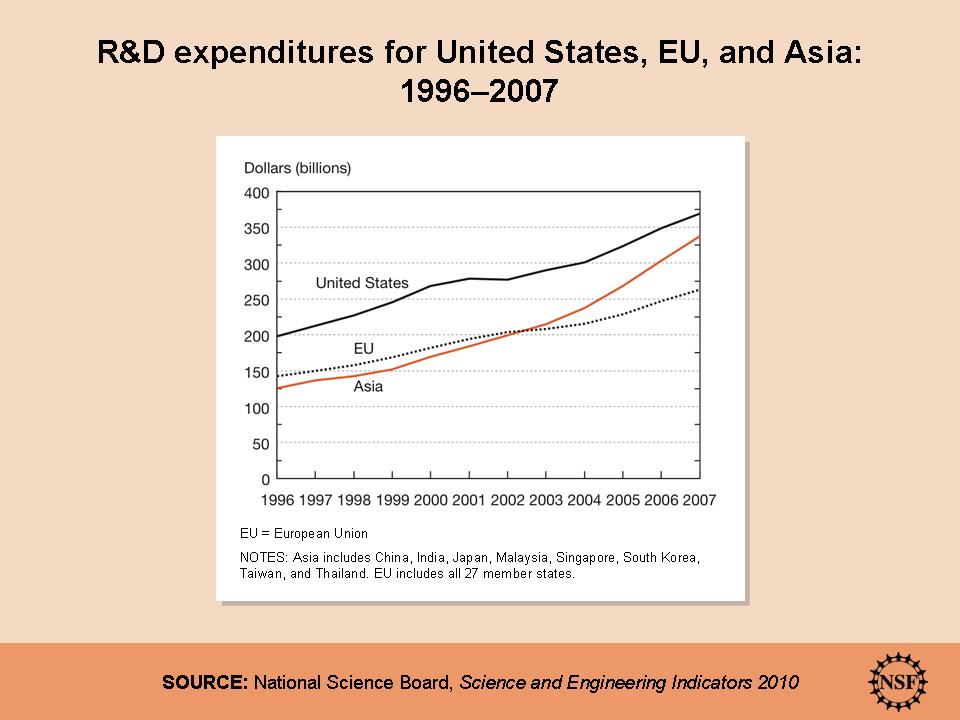
Useful Stats: “Eroding Dominance” Theme of S&E Indicators 2010

Wednesday, January 20, 2010

Current trends presented in the 2010 edition of the National Science Board’s biennial Science & Engineering Indicators suggest as early as the 2012 edition, the U.S. will no longer leads the world for a key indicator: total R&D expenditures – unless corrective action is taken.


  • Read more about Useful Stats: “Eroding Dominance” Theme of S&E Indicators 2010

Useful Stats: Measuring the Returns to R&D

Wednesday, January 6, 2010

There is no simple answer to a frequently asked question that SSTI receives: what should we expect to be a good return on public investment in research? A new working paper available from the National Bureau of Economic Research helps clarify the range of possible answers, though, and strongly suggests the investment is worthwhile.

  • Read more about Useful Stats: Measuring the Returns to R&D

AK Gov’s Capital Budget Includes $109.5M for Life Sciences Facility

Wednesday, December 16, 2009

To help train future scientists and support cutting-edge research in health and environmental issues, Alaska Gov. Sean Parnell is recommending $109.5 million in the FY11 capital budget for the University of Alaska Life Sciences Facility in Fairbanks. The multi-purpose teaching and research facility would house the Department of Biology and Wildlife and accommodate a wide-range of research programs, reports Fairbanks Daily News-Miner.

  • Read more about AK Gov’s Capital Budget Includes $109.5M for Life Sciences Facility

SD Gov Asks Lawmakers to Fund Research Priorities in FY11

Wednesday, December 16, 2009

To keep alive the underground deep science laboratory, a National Science Foundation (NSF) research priority for scientific discovery in geophysics, Gov. Mike Rounds is asking lawmakers to approve $5.4 million in special appropriations for bridge funding through May 2011. During his budget presentation to the legislature last week, Gov. Rounds told lawmakers the $35 million allocated toward the effort in 2004 and 2005 would run out this month and $250 million in anticipated NSF funding would not be available until 2011.

  • Read more about SD Gov Asks Lawmakers to Fund Research Priorities in FY11

Useful Stats: State R&D Expenditures, Intensity per State: FY 2006 & 2007

Wednesday, December 9, 2009

In FY2007, the states in aggregate expended $1.23 billion in funds for research and development, according to recent data released by the National Science Foundation. This is the second year consecutive annual data from the NSF's State Agency Research and Development Expenditures series has been produced. SSTI has prepared a table that shows for both FY07 and FY06 each state's expenditures for R&D from the state government, the state's GDP, and the spending intensity as measured by R&D expenditures per million dollars of GDP.

  • Read more about Useful Stats: State R&D Expenditures, Intensity per State: FY 2006 & 2007

Virginia Governor Announces $25 Million in Possible Funding for Medical Research Institute

Wednesday, December 2, 2009

Virginia Governor Tim Kaine announced the creation of The Ignite Institute, a nonprofit medical research institute to be housed initially at the Center for Innovative Technology. The state will provide $3 million from the Governor's Opportunity Fund and $22 million in incentive grants, subject to General Assembly approval. The institute expects to draw $200 million in initial financing and create 415 jobs. Read more at: http://www.ignitehealth.org/.

  • Read more about Virginia Governor Announces $25 Million in Possible Funding for Medical Research Institute

Pagination

  • First page « First
  • Previous page ‹‹
  • …
  • Page 8
  • Page 9
  • Page 10
  • Page 11
  • Page 12
  • Page 13
  • Page 14
  • Page 15
  • Page 16
  • Next page ››
  • Last page Last »

Tags

Select up to 5
  • (-) R&D (390)
  • higher ed (96)
  • useful stats (76)
  • NSF (51)
  • manufacturing (25)
  • State TBED (25)
  • commercialization (24)
  • tax credits (24)
  • bio (21)
  • energy (20)
  • state budget (19)
  • federal agency (17)
  • international (17)
  • capital (16)
  • workforce (16)
  • policy recommendations (15)
  • dept of energy (14)
  • innovation (13)
  • stats (13)
  • STEM (13)
  • NIH (11)
  • Federal Agency R&D (10)
  • cleantech (9)
  • entrepreneurship (9)
  • recent research (9)
  • small business (8)
  • white house (8)
  • SBIR (7)
  • intellectual property (6)
  • SSTI features (6)
  • strategic plan (6)
  • angel capital (5)
  • benchmarking report (5)
  • funding (5)
  • k-12 (5)
  • research (5)
  • tech transfer (5)
  • broadband (4)
  • dept of defense (4)
  • economic development (4)
  • federal budget (4)
  • legislation (4)
  • nanotech (4)
  • policy (4)
  • SBA (4)
  • tech talkin govs (4)
  • big data (3)
  • GDP (3)
  • NIST (3)
  • R&D tax credits (3)

Recent news from the SSTI Digest

Place-based innovation comes of age: Federal regional innovation programs are reshaping America's technology economy

Wednesday, August 5, 2026
Strong regional ecosystems connect universities, entrepreneurs, investors, manufacturers, workforce organizations, and state and local governments. Rather than supporting just isolated institutions, federal agencies are now investing in collaborative regional networks capable of translating research into new companies, industries, and jobs. The intent is not for every region to become the next Silicon Valley, but to enable regions to compete by organizing around what they already do well.
NSF
EDA
tech hubs
NSF Engines

Takeaways from the ACA angel capital report

Wednesday, August 5, 2026
As SSTI noted in its recent look at quarterly investment activity, gaining insight into angel investment is difficult because of the challenges of separating angel activity from seed and other early VC transactions. Fortunately, the Angel Capital Association (ACA) recently published a report that provides a deep dive into 2025 angel investment activity and provides more clarity on this important financial partner for regional innovation. The big picture takeaway from the ACA report is that, like VCs, angel groups are making larger investments in fewer companies. 
angel capital

State grant programs support manufacturers and improve their competitiveness

Wednesday, August 5, 2026
As those involved with the longstanding, internationally recognized program know, an air of uncertainty has enveloped NIST’s Manufacturing Extension Partnership (MEP) for the past two years. With the release of the new Notice of Funding Opportunity (NOFO) for MEP Centers (see SSTI’s write‑up here), it appears that perhaps many of those troubles may be in the past. Even so, the uncertainty has prompted many manufacturers, small businesses, and MEP centers to explore alternate funding sources, partnerships, and forms of assistance beyond NIST.
MEP
states
State Science & Technology Institute (SSTI) logo

Footer

  • About
    • Board
    • Staff
    • Membership
    • TBED Community of Practice
  • Join
    • Member Benefits
    • Member List
  • Join SSTI
  • Sign up for SSTI Digest

© 2025 SSTI, All Rights Reserved.

1391 W 5th Avenue Ste 323, Columbus OH 43212

614.901.1690