
California outranks all other U.S. states in value of agricultural outputs. And the bulk of that production takes place in the Central Valley. It produces more than 250 different crops with an estimated value of $17 billion per year. Drawing from only 1% of U.S. farmland, the region supplies 8% of U.S. agricultural output (by value) and produces 25% of the nation's food, including 40% of the nation's fruits, nuts, and other table foods.
However, as farm operations become increasingly automated, many of the farm workers who produce this food could get left behind. Karen Aceves, founder and CEO of ARKEN Strategies, mentioned the growing use of drone technology for pest control as an example. "The technology is moving fast," she said. "What used to be several people who used to spray the fields is now one person who needs to have a pilot's license to operate a drone."
Due to automation, one in three farm workers’ jobs may not be required in the future, according to a recent study by ARKEN Strategies. This shift has created uncertainty for the industry about what operations will look like five years from now, leaving them more hesitant to hire. "They need people that are more adaptable," said Aceves. "They need to know that if their operations shift, they have employees who can shift with them or understand the different systems."
In September 2022, the U.S. Economic Development Administration’s Build Back Better Regional Challenge awarded the F3 (Farms Food Future) Initiative $65 million—the largest federal grant ever awarded to California’s Central Valley. The California Department of Food and Agriculture, an F3 AgTEC partner, funded ARKEN Strategies to launch, build, implement, and evaluate an F3 program called the F3 AgTEC Workforce Initiative (AgTEC). Working alongside participating community colleges, faculty, farmworker organizations, and agricultural industry partners, ARKEN Strategies helped lead the design and implementation of an educational model grounded in both the realities of agricultural work and the experiences of the people the program was intended to serve.
AgTEC is positioning the Central Valley’s ag-based industry and farmers to be competitive, resilient, and sustainable as the Central Valley adopts automation. It is creating an educational pathway that could help farm workers transition from traditional, non-automated farm jobs to positions that require some education and new skill sets for working on farms using automation.
A first step in developing the AgTEC program was to launch a survey of farm workers and employers. The farmworker organizations in the coalition gathered 12,000 surveys from places such as churches, Zumba classes, quinceaneras, community groups, and health clinics. Of those 12,000 surveys, 10,856 were validated and included in the final dataset.
“One of the biggest things we learned through the farm worker survey was that farm workers have dreams, and many of those dreams are not about agriculture,” said Aceves. “About 25% of those surveys said they were interested in ag tech. The rest were interested in things like nursing, welding, and entrepreneurship.”
With the reduced workforce required in future agricultural production, a one-in-four finding of long-term career interest is probably a good thing. ARKEN Strategies concluded that programs for farm workers should open opportunities that don't restrict them to agriculture. The firm also concluded that the biggest obstacle for most farm workers is flexibility, because most said their schedule changes constantly: harvest seasons vary, and sometimes they work nights to avoid the heat. Despite these obstacles, most (over 60%) said education was either important or very important to them.
However, Aceves noted that, despite their desire to pursue education, farm workers lack easy access to the education system; they have traditionally been locked out of the workforce development pipelines that serve other industries.
The AgTEC program had a rough start. "We listened to farmworkers, we listened to industry, we built it, we launched it. But very few people came into the first cohort,” said Aceves.
Upon further investigation, ARKEN Strategies realized that none of the Hispanic-serving institution college websites were in Spanish. They also realized that many potential participants didn't have computers or email addresses. As a result, more than 80% of potential participants dropped out during the initial application process.
ARKEN Strategies and their community partners then developed a program to retrain farm workers that better matched their needs. They spent two years building an on-ramp for farm workers to obtain an education that never existed before.
The AgTEC program is based on competency-based education (CBE), a format fitting for the AgTEC students, because their educational background was atypical, as compared to other college students. In a recent survey of 50 participants, 64% had a high school diploma or less. As ARKEN strategies stated in its report on the survey, "This is a population that has been substantially excluded from credential-based workforce systems,” said Aceves. “The program's ability to meet them at their current level while delivering industry-recognized skills is its defining structural contribution."
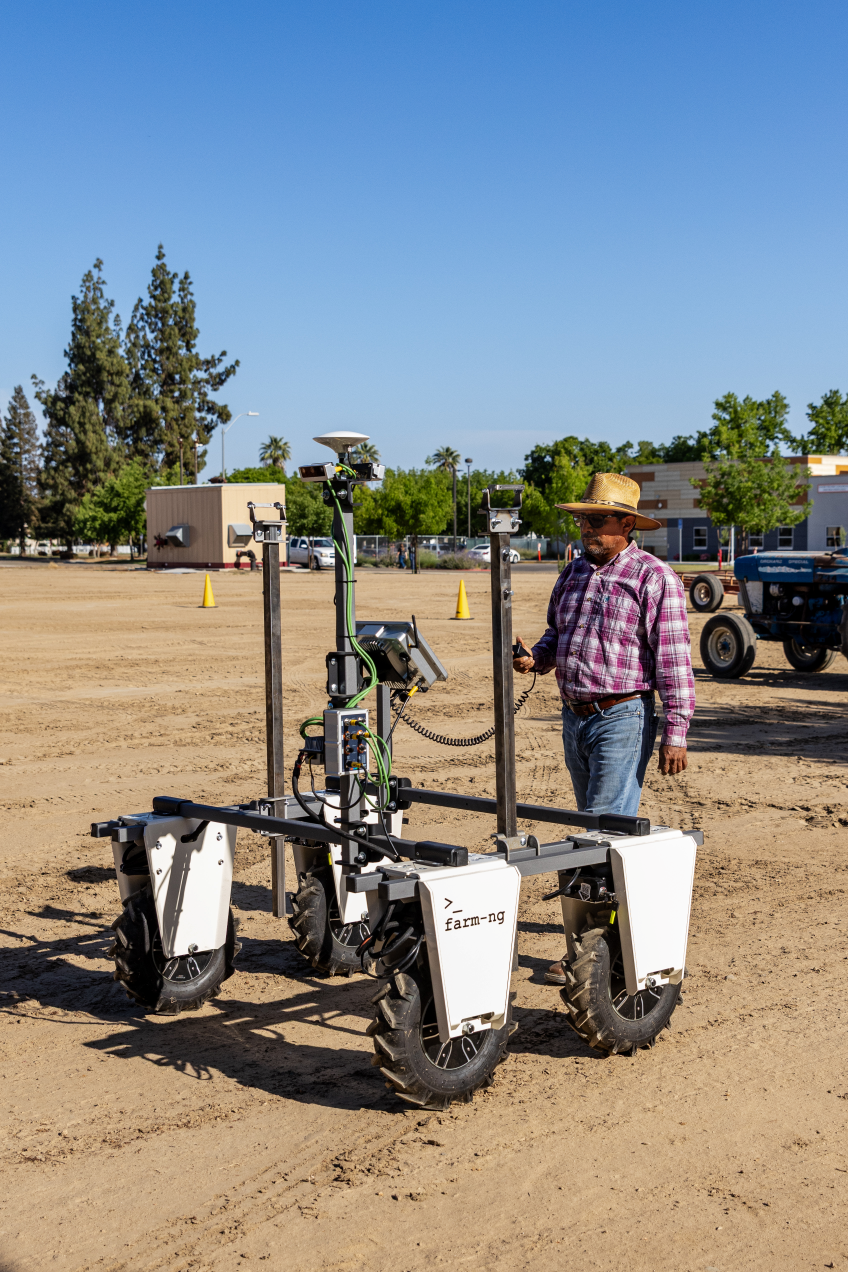
An AgTEC student gets hands-on experience using robotic tractors. These sessions help students showcase and build upon their existing skills in operating machinery, troubleshooting, and farming technology—key components of the Career-Based Education (CBE) learning model.
A critical component of the AgTEC program is its grant-funded pathway navigators. Travis Blackstock, an AgTEC Instructor at Fresno City College, commented in a video about the AgTEC program that “One of the most important positions is our pathway navigators. They do outreach. They help our students with enrollment, registration, and so many other necessities throughout the process. Many of our students are first-time college students, and it can be a daunting task to get started, even more so if you're already working in the industry or in other places.”
The pathway navigators are paid through the BBBRC grant. The model is unique, says Aceves, because it allows pathway navigators to dedicate all their time to one program—a finding that should have applications in other fields as well.
Ninety-four percent of survey respondents wanted to continue their education. "That result tells me everything," said Aceves. "(The program) is not another barrier that they need to overcome. When we're upskilling farmworkers, we're not offering just the one certificate; we're giving them an avenue for education, the ability to dream, the ability to decide what they want their future to be." “In the final year of the [federal] grant, ARKEN Strategies is building an associate's degree so people have “a place to land,“ Aceves added.
Currently, AgTEC Workforce offers an AgSystems Certificate through six local community colleges. Students can take the entire course as noncredit and later convert it to credit if they choose. Taking the course is free, since California offers free tuition for all noncredit courses.
Aceves notes that the timing of building the on-ramp—before farm work became primarily automated—was critical. If they waited for automation to overtake these jobs completely and then built an on-ramp, it would already be too late. "We were able to get a little bit ahead of that curve," she said. "So now we have a pipeline to where when that automation comes, we have those systems ready to go to train. We got through the training in Spanish, the CBE, the flexibility; all those systems are already in place at those colleges to be able to start programs on top of that."
What began as an effort to create more accessible education pathways for agricultural workers in California’s Central Valley is now demonstrating its potential to scale beyond the region. Through AgSTEP, the model is expanding to colleges in the North State, Central Coast, and Imperial Valley using the same core curriculum and competencies developed through the original AgTEC initiative. These colleges are building on an established educational framework, working with local employers and faculty to validate and adapt it to their regional workforce needs. The expansion demonstrates how an initial regional investment can create a shared foundation for workforce education that can be replicated across California and beyond while remaining responsive to local industries and communities.