
What do turfgrass and grapes have in common? Both are high-volume, high-value crops. And, as field trials by the Pacific Kelp Company are proving, both could also benefit from the nutrients in liquefied kelp extract, a biostimulant product that also could help boost the sales of Alaska kelp with adoption of broader applications.
Alaska kelp farming got its start in 2017 but remained a minor player in the overall Alaska mariculture economy. In 2022, however, the Alaska kelp industry got a significant boost: Southeast Conference was awarded a $49 million U.S. Economic Development Administration (EDA) Build Back Better Regional Challenge (BBBRC) grant to grow the kelp and oyster industries in Alaska.
Southeast Conference, Southeast Alaska’s economic development district, leads the Alaska Mariculture Cluster (AMC) grant coalition, which is guiding the BBBRC’s grant work. The AMC’s vision is to grow the oyster and kelp sectors into a $100 million industry in ten years and a $325 million industry in 20 years. One of many programs they have funded to this end is the Kelp Agricultural Product Development Program, which comprises projects to explore the biostimulant properties of liquid kelp extract and develop a market for it.
AMC has awarded close to $1 million for field trials to test kelp products. Pacific Kelp Company is one of various Alaska awardees; they received $537,000 to conduct field trials of their kelp-based biostimulant, KelpEdge.
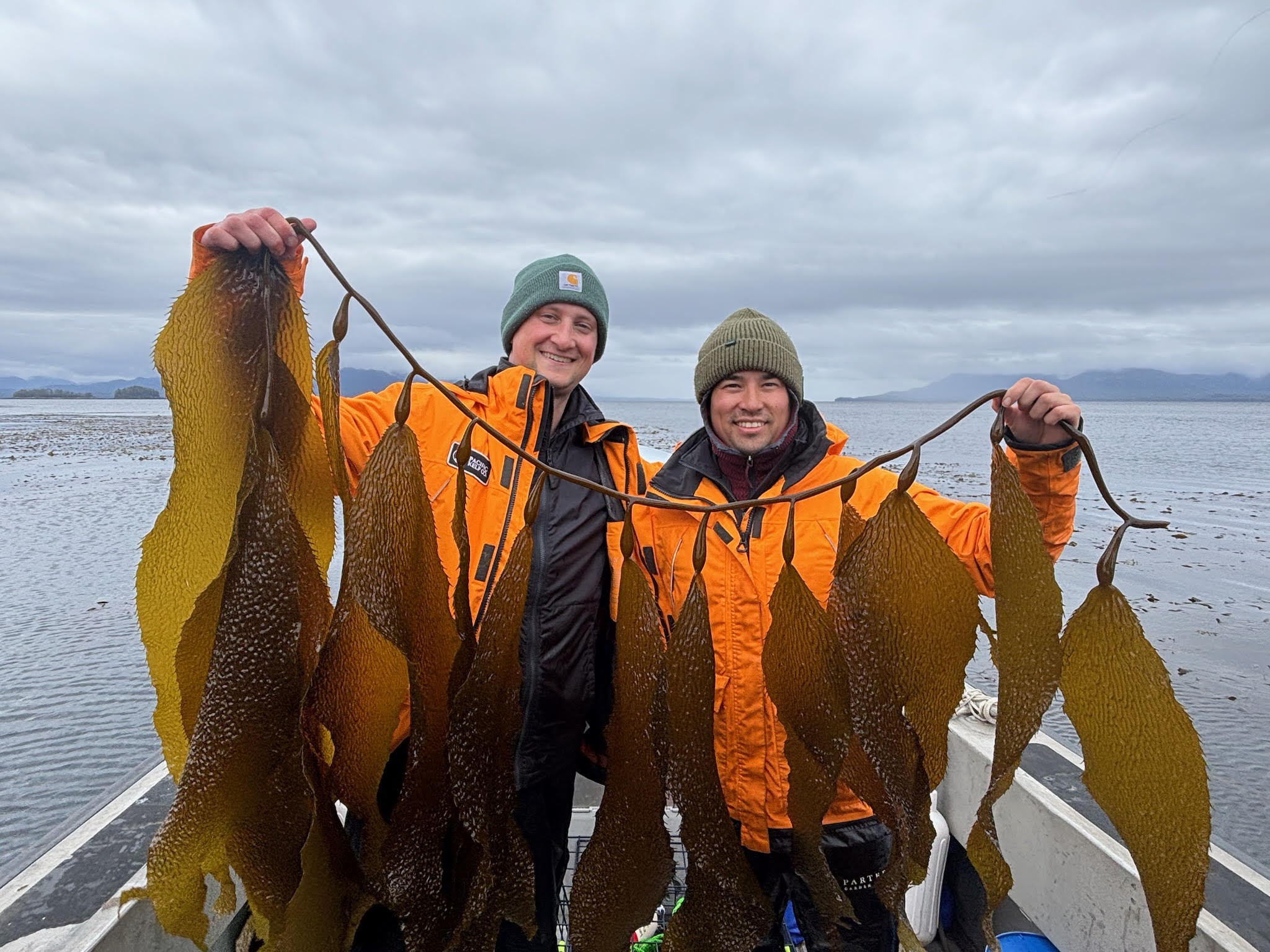
Pacific Kelp Company co-founders John Smet (L) and Nick Stern (R) holding Giant Kelp.
The potential value of kelp is evident in its long history of use in gardens in coastal areas around the world. “It’s not hard to imagine there’s value there,” said Dan Lesh, deputy director of Southeast Conference. “What’s harder to imagine is how to have a supply chain that is cost-efficient.”
Lesh noted that the size of the BBBRC grant allows AMC to tackle various parts of the supply chain as they look at building a kelp industry in Alaska. The Kelp Agricultural Product Development Program is working to validate and strengthen the market for liquid kelp extract, a biostimulant product for agriculture through field trials. The two main studies Pacific Kelp Company is working on as part of this grant involve turfgrass and wine grapes.
There is precedent for demand for kelp-based products, which, in addition to producing biostimulants for supplemental feeding of plants, can also be used in beauty products, food, and animal health. The main buyer of Alaska kelp in 2026 is Cascadia Seaweed, a biostimulant producer that bought 650,000 pounds of Alaska kelp this year, a significant increase from previous years.
The turfgrass and wine grape field trials aim to quantify KelpEdge’’ s benefits. KelpEdge is derived from giant kelp, a different kelp species than what is used in a majority of kelp biostimulant products. The field trials could discover unique properties and benefits for turfgrass, grapevines, and other crops.
“While many farmers may have heard of biostimulants, including kelp, fewer are actually using them. So there’s a level of skepticism that needs to be overcome for somebody to give you money and to trust that the product is not going to hurt their plants and is going to help with yield or growth or stress tolerance,” said John Smet, a co-founder of Pacific Kelp Company.
Improving stress management for turfgrass is particularly important because it is mostly placed in parks and golf courses, where it is typically subjected to heavy foot traffic. “The need to keep grasses happy and alive and green is important,” said Professor Kyle G. Wickings, who is leading the turfgrass field trials at Cornell AgriTech. “Anything that can help to mitigate that stress is really helpful in the industry.”
Wickings is also investigating whether soil health changes in response to the use of KelpEdge, an area in which Wickings said biostimulants have gotten “a lot of interest.”
The field trials involving grapes aim to evaluate how the kelp extract can positively influence growth characteristics and fruit quality, particularly in challenging conditions. “This improvement, particularly in secondary metabolites, is promising for winemaking, as these compounds are highly sought after,” said Associate Professor Bhaskar Bondada, who is leading the wine grape field trials at Washington State University. He also noted that because KelpEdge is derived from different species of kelp than other biostimulants, it may introduce “unique properties and benefits that could further support the health and productivity of grapevines.”
“The initial findings are encouraging and suggest that kelp could play a valuable role in enhancing the grape industry, especially considering the challenges posed by climate change,” Bondada added. “We are optimistic that these applications will increase the resilience of grapevines, helping them better withstand stressors like drought.”
Now in their second year, the field trials are beginning to yield results. The field trial results show a significantly increased estimated return on investment for producers using KelpEdge. Depending on the growers’ practices and conditions, Pacific Kelp Company estimates that:
-
A 2025 wine grape field trial showed an estimated total net benefit of $425–$1,855 per acre.
-
Another 2025 wine grape field trial testing KelpEdge in drought conditions showed an estimated total net benefit of $280–$860 per acre.
-
A 2024 turfgrass trial looking at KelpEdge’s effects on root system performance and soil health economics showed an estimated net benefit of $592–$2,224 per acre.
After seeing positive results in their turfgrass and wine grape field trials, Smet and his cofounder, Nick Stern, conducted field trials in other crops of interest to farmers that also showed significant estimated net benefits. For example, KelpEdge generated an estimated return of $512–$1,024 per 1,000 sq. ft. for greenhouse tomatoes.
Pacific Kelp Company sells its kelp-based biostimulant to consumers, such as home gardeners and commercial farmers. They sell to the home gardener segment on Amazon, on their website, in home and garden stores, and through distributors. “Those sales are going well,” said Smet. “It ramped up very quickly, and we’re getting good customer feedback.”
The commercial farmers using their product have fields ranging from 2 acres to 10,000 acres. “We work with players across the ag industry, from small specialty crop farmers to large row crop farmers,” said Smet. The company works mostly with distributors and agronomists who help their farmer-clients decide which inputs they want to purchase. “That’s where the field trials become really important,” said Smet. “Communicating the results of those trials is different than it is to somebody who has a home garden. That process is also going very well, but it takes a lot longer than the commercial side of things.”
Stern added that he is happy with the traction they’ve experienced so far. He notes that “We’re slowly building more states as we get more channels and distribution and customers in them,” he said. “And we have good capacity. It’s just a matter of building the demand so that, once we have buyers lined up and its high volume, we can turn around and start buying and moving Alaska kelp.”
AMC grant funding has boosted Pacific Kelp Company and other companies awarded AMC grants through the BBBRC. “The grant program has been incredibly impactful and valuable to us as a company,” said Smet. “The amount of money that we’ve gotten just for this R&D grant for the field trials was almost a third of the total capital that we’ve raised as a business. And people respect the institutions that we’re working with. Having data from those institutions, from a marketing and from a sales perspective, is incredibly valuable.”
“We were able to make significant progress with the help of this grant,” said Smet. “Without the grant, it would have been a much slower ramp, and it would have been smaller and less impactful.”
Lesh is confident that large-scale kelp farming in the ocean will be part of the kelp industry supply chain and part of Alaska’s economy. However, the BBBRC grant is on a five-year timeline, which Lesh says may not be long enough to see the full impact of the field trials. He noted that it will take time, and concerted efforts, such as the BBBRC grant, are needed to make that happen.
“We’re excited about biostimulants,” said Lesh. “It may be a good fit for Alaska. It’s also more market-ready at a time when kelp really needs markets.”