
The Maine Technology Institute’s core mission is to use innovation to spur the development of new products, processes, and companies that strengthen the state’s economy. Finishing its 25th year of operations, MTI solidly illustrates how a sustained, focused yet flexible and creative strategy can deliver this mission. MTI has disbursed $387 million across 4,350 distinct projects throughout Maine since its founding, and that funding has leveraged over $2.2 billion in private sector matching investment.
“MTI is a unique public-private partnership,” noted Brian Whitney, president of MTI, in a recent email exchange with SSTI. “We receive an annual appropriation from the state’s general fund, and we are asked to deploy it to catalyze innovation in the state’s seven targeted technology sectors.” These seven sectors, according to MTI’s latest annual report, include both mature industries (such as forestry and agriculture) and emerging ones (such as composite materials).
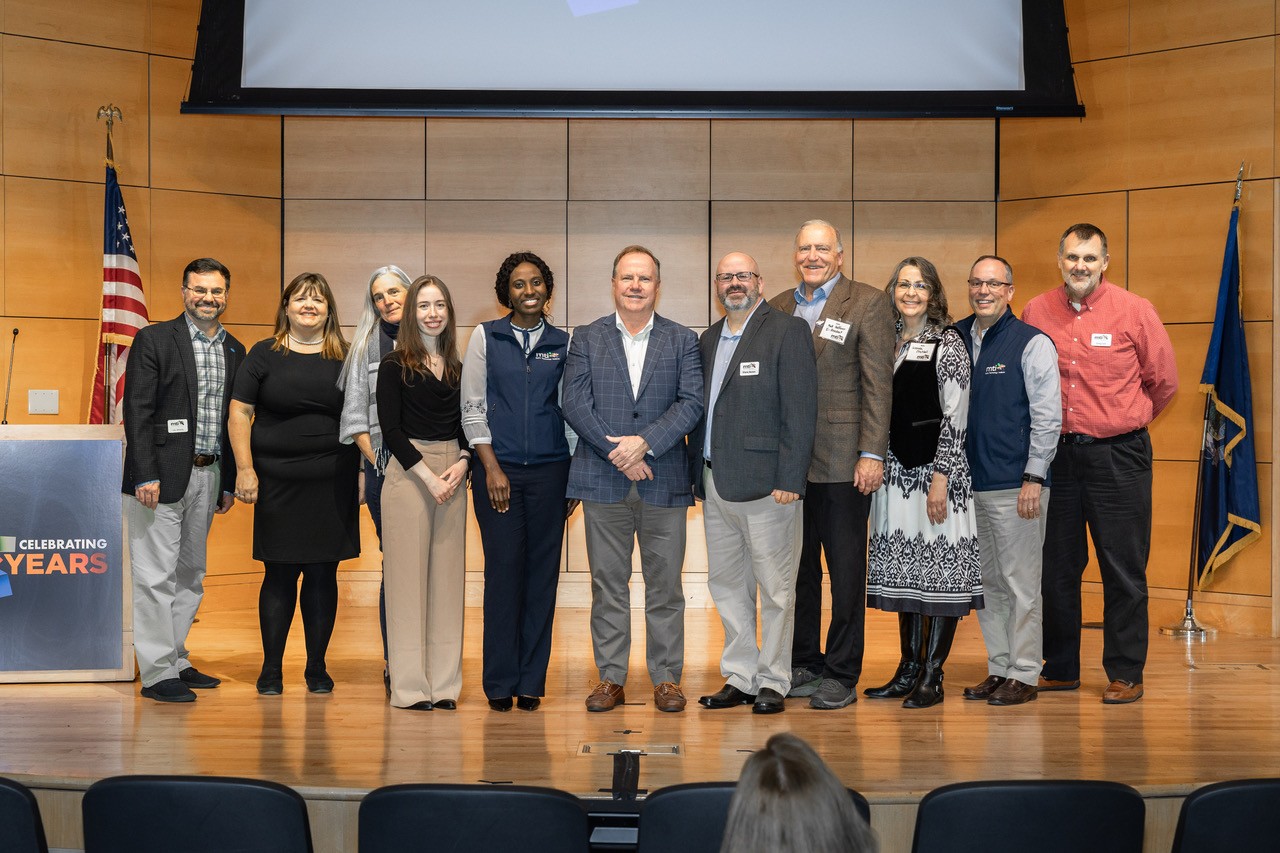
Above: The MTI Team
In FY25, MTI invested in early-stage technology businesses within all seven targeted sectors. Each of these companies is tackling a challenging problem within their respective sectors. For example, Bluesonde Technologies, a marine sector company, is rethinking how water-quality data is gathered and maintained. According to the Bluesonde case study in the annual report, “(w)ater steward organizations need continuous, precise data on marine and freshwater ecosystems for accurate condition assessments. For years, the work has been limited by equipment that’s hard to deploy and even harder to service.”
Bluesonde had a solution, but to move from concept to working product, the team needed more resources. MTI helped with Business Innovation Grants and a Technical Assistance Program. These resources enabled Bluesonde to assess markets, focus on those ready for adoption, and advance product development. A testimonial in the MTI Annual Report from John Williams, cofounder of Bluesonde Technologies, states, “Access to MTI’s early-stage funding has been one of our biggest advantages. Many startups struggle to secure capital before they are ready for angel or VC investment, and MTI’s tech-focused grants help bridge that gap and accelerate progress.”
Bluesonde was one of 307 companies that received a total of $8.04 million in funding awards from MTI in 2025. These awards are offered as grants, loans, equity investments, and services. Innovation Grants are scaled based on company need and potential, ranging from less than $25,000 to $250,001 or more. Bluesonde received three small grants from MTI totaling $100,000.
In addition to the grant, MTI’s Technical Assistance Program (TAP) helped Bluesonde develop a competitive SBIR/STTR proposal. MTI’s TAP proposal development service is free for clients.
Supported by funding and technical assistance from MTI, Bluesonde has developed its first functional prototype: a compact, smart buoy that can be quickly dropped into the water. Several organizations are planning for 2026 deployments following successful trials.
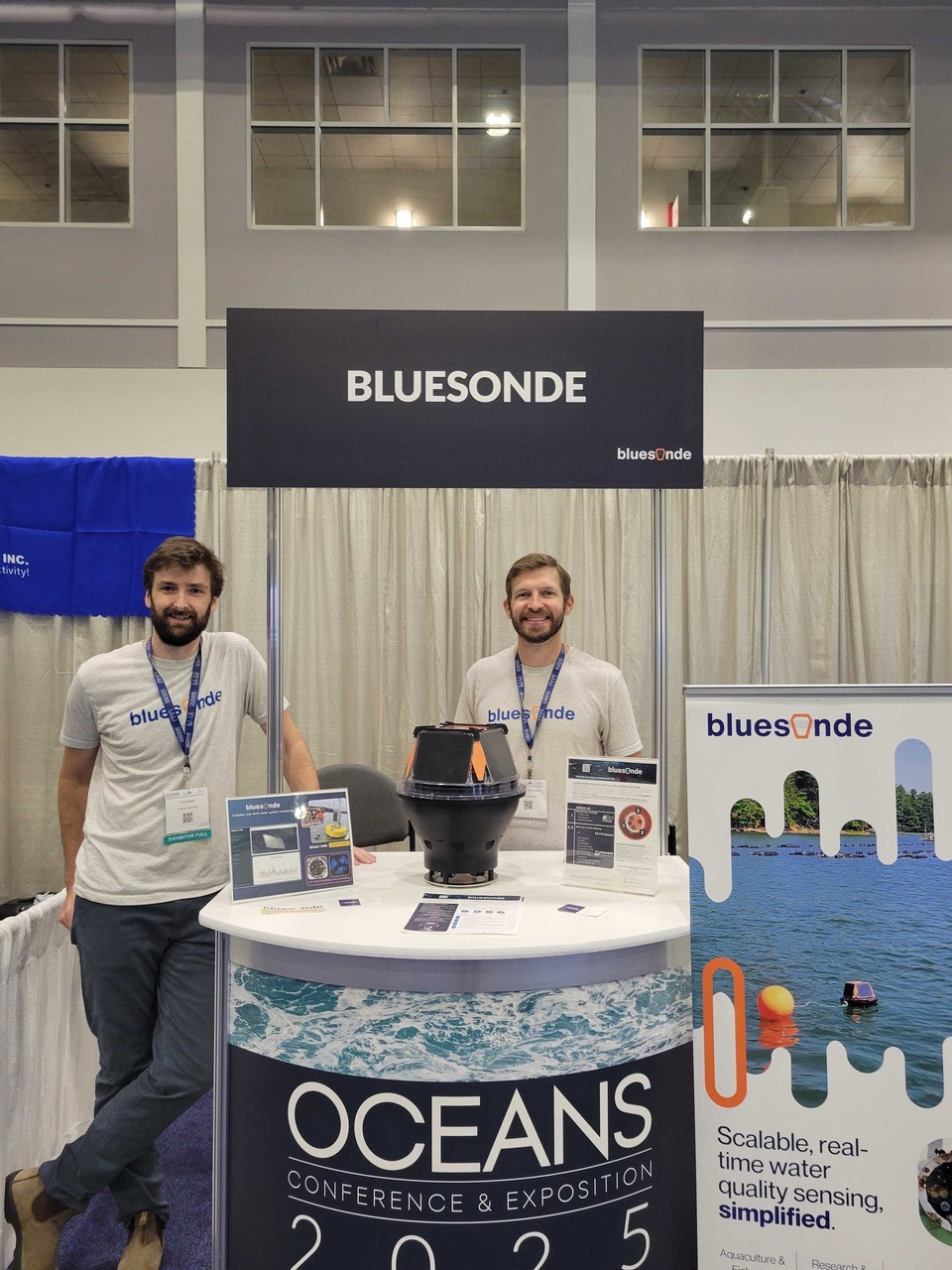
Above: Bluesonde cofounders
Tim Dyson (L)
and Andrew Thompson, CEO (R)
Like Bluesonde, each company that MTI supports has a story of how it parlayed that support into benefits for Maine’s economy (the annual report highlights five, including Bluesonde). “As you can see from our most recent annual report, MTI’s impact on early-stage businesses is profound,” noted Whitney. “After friends and family, our money is typically the first money injected into a firm.”
“We were created by the legislature to take risks that most investors and traditional funders avoid,” Whitney added. He cited Steve Case’s book, The Third Wave, noting that it addressed the government’s role in entrepreneurship. Case wrote,
It will always be government that defines—either through action or inaction—the environment in which entrepreneurship operates. At its worst, a hindrance creating maddening obstacles. At best, creating an environment where innovation and entrepreneurship thrive, not by providing the certainty of success, but by mitigating risk and expanding the scale of opportunity.
“True to Case’s words,” said Whitney, “MTI’s role in supporting early-stage businesses is to help mitigate some of the risk to help facilitate and expand the scale of opportunity.”
MTI has a governance structure that spans all geographic areas and touches all targeted sectors, enabling statewide buy-in to promote entrepreneurship and innovation. Whitney noted that
MTI is governed by a 16-person board of directors made up of 10 individuals from the private sector and six from the public sector—all appointed by Maine’s Governor. We also have seven advisory boards representing each of the state’s targeted technology sectors. The advisory boards are made up of subject-matter experts who volunteer their time and expertise to evaluate the feasibility and merit of the funding applications we receive. We use their reviews and an external financial review, along with our internal staff and investment committee assessments, to make funding decisions. The governing board and the seven advisory boards complement each other well and have proven to be a successful model for more than 25 years now.
Looking ahead, MTI’s ability to positively influence the state’s innovation economy is expected to remain strong. “Given that MTI serves as the lynchpin for Maine’s innovation-driven economy, we are often asked to take a leadership role in implementing new strategic initiatives for the State of Maine,” wrote Whitney. He noted that, in the year ahead, MTI plans to:
-
Deploy $25 million in funding from an R&D bond to help develop R&D infrastructure and assets in the public and private sectors and help create and retain quality jobs for Mainers.
-
Lead the state’s effort to build a stronger, more connected life sciences ecosystem in Maine. “The new Maine Life Sciences Center (MLSC) will be administered by MTI and will be focused on laying the foundation—aligning partners, catalyzing high-impact projects, and demonstrating early wins that prove the value of coordinated leadership and investment,” noted Whitney. “Success will be measured by visible momentum, stronger collaboration, and a clear case for sustained public and private investment.”
-
Fund—in alignment with the Maine Life Sciences Center initiative—the creation of a privately managed Life Sciences Incubator in Southern Maine to provide wet lab equipment, infrastructure, and services to support startups engaged in the life sciences sector.
-
Provide strategic leadership to vault Maine forward in the global space economy. “Recognizing that Maine can play a meaningful role in commercial space market and, in particular, the small satellite market, MTI will provide the administrative backbone for the Maine Space Corporation to help generate between $550 million to $1.1 billion per year to the state’s GDP by 2042 and creating between 2,800 and 5,500 good-paying jobs annually during the same timeframe,” noted Whitney.
Read MTI’s Annual Report 2025 here.