
NOTE: Moving engineers, scientists, and technologists out of the lab when they have a promising technology is the best way to ensure success for the individuals, the innovation, and the resulting company. This transition is one of the biggest challenges for lab 2 market programs and technology commercialization efforts. Fortunately, some models for assistance toward the path to success are emerging in regional innovation, university tech offices, and the nation’s federal labs. This item in our TBED Works series describes how the public-private partnership for innovation-driven growth may come together to yield positive results ~ Mark Skinner.
Most people have seen stopped-action images of things like a hummingbird’s wings as it sips on nectar, or of a balloon popping. But until recently, most people, including nuclear fusion scientists, had never seen what happens inside a nuclear fusion reactor. The plasmas are moving too fast for conventional cameras to capture—about 500 to 1000 times faster. And besides, how could anyone get a camera so close to an event that can generate radiation on par with a nuclear weapon?
This was a challenge that engineers Liam Claus and Marcos Sanchez successfully worked on as employees of Sandia National Laboratories’ Microsystems Engineering, Science and Applications (MESA) complex for more than two decades and then as entrepreneurs in their spinout company, Advanced hCMOS Solutions (AHS). The founders were helped along the way by programs like Energy I-Corps and the Entrepreneur Separation to Technology Transfer (ESTT) program. More on those initiatives later.
MESA develops microelectronics and microsystems for the National Nuclear Security Administration (NNSA). At MESA, Claus and Sanchez developed an imaging sensor that can capture motion in multiple frames with shutter speeds that operate at a billionth of a second (the time it takes light in a vacuum to travel roughly a foot). For added measure, the sensor can do this in close proximity to nuclear fusion and other high-energy density physics (HEDP) experiments.
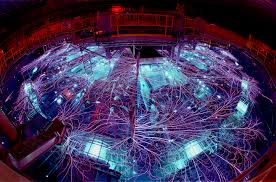
For just 100 nanoseconds, Sandia National Laboratories’ Z machine
releases roughly 200 trillion watts of x-ray energy.
Photo by Randy Montoya
Z Pulsed Power Facility, the HEDP and fusion physics research facility at Sandia, had commissioned MESA to create a digital camera that could shoot multiple frames of data at ultra-high speeds to allow it to capture non-repeatable high-speed phenomena conducted in the Z machine experiments. The research experiments performed on Z focus on a variety of areas, such as the study of matter under extreme conditions to shock wave propagation.
At the time, Z machine was using image plates, similar to what a dentist might use to get an X-ray image of a person’s teeth. However, as Claus explained, “their experiments evolve on very fast timescales and they're oftentimes non-repeatable. One target may behave one way, and another target may behave another way, even if the researcher is trying to repeat it. There are inherent inconsistencies within these experiments.” John Porter, a manager at Z machine, asked Claus, “Why, in the year 2006, do we not have digital cameras?”
MESA assigned Claus and Sanchez the task of coming up with a solution for Z machine. Claus noted that the solution Z machine was requesting had never been done before, and that it was something that would have a significant impact on fusion and nuclear weapons research. “It was for extremely focused, very specific types of research, which is this high energy density physics, and that high energy density physics can be fundamental science, studying things like black holes. But it also can study fusion and nuclear weapons effects. And so, there's a very important mission space for that,” said Claus.
There are other scientific cameras that can capture images at a billion frames per second, but they can only take one frame of data. “What's special about our technology and why it's considered transformational is that we can take images at a nanosecond time scale—events that are occurring at approaching the speed of light—and we can acquire multiple frames of that image,” said Claus. “So, we make a very, very fast, very, very short movie.” Claus offers, as a frame of reference, the explanation that the slow-motion feature on an iPhone shoots 240 frames per second, whereas their camera shoots at a billion frames per second. The fastest commercially available cameras can shoot close to 2 million frames a second.
“They are building tools to expand what scientists can observe and understand,” said Kistin. “And so, this is very much a tool that is leveraged by the research community that is expanding into areas like fusion. This can be something that helps enable big leaps in the realm of the possible. It's an enabling technology, a component of larger systems.”
Sanchez and Claus developed a reputation at the national labs as problem-solvers in this space. As the word spread, their expertise was in demand. “It was getting to the point where we could not spend enough time on each project,” said Sanchez. Porter, along with Perry Bell, a diagnostics manager at Lawrence Livermore Laboratories, became strong supporters of Claus and Sanchez creating their future company. But Claus and Sanchez wondered how they could transition from “nerds” who know “nothing” about business into businesspeople.
Luckily, Sandia offers programs for employees considering entrepreneurial endeavors. Sanchez and Claus met with David Kistin, manager of technology and economic development at Sandia’s Technology Partnerships Group. This group manages the entire commercialization cycle, including licensing, entrepreneurial programs, employees’ participation in Energy I-Corps, the Entrepreneur Separation to Technology Transfer (ESTT) program, and the technology readiness initiative, TRGR. Sanchez and Claus started talking to Kistin and his team.
Kistin introduced Claus and Sanchez to Energy I-Corps, an initiative of the U.S. Department of Energy's Office of Technology Commercialization. “They worked on this product and this technology for years at the labs, but Energy I-Cops was the first step where they could test and understand if this is something that could transfer outside of the national lab infrastructure and become a viable product,” said Kristin.
“Energy I-Corps was probably the most seminal program that we did that gave us the background and, for me, the courage to say, ‘I want to create a company out of this technology,” said Sanchez.
Sanchez and Claus’ next step was to leave Sandia and work on their company full-time. They enrolled in Sandia’s ESTT program, which allowed them to formally separate with the option of returning within three years with their same job title. “For me, ESTT was the most important program that Sandia offered that enabled us and gave, at least for me, the courage to be able to do this,” said Sanchez
Claus and Sanchez formed their company, AHS, in 2021 and separated from Sandia on January 1, 2022. Now, four years into their company, they have no regrets about going out on their own. “They are very happy right where they are,” said Kistin. “Which is an ideal outcome for us. The separation is a safety net for folks that are leaving, but what we really want is to see these technologies thrive in the market. And these guys are definitely thriving.”
The Technology Partnerships Group continued to interact with AHS after they left Sandia as they would with any other external partner. Their main interaction was through TRGR, Sandia’s technical assistance program. This initiative provides New Mexico businesses (e.g., not limited to Sandia spinouts) the opportunity to work directly with scientists and engineers at Los Alamos or Sandia National Laboratories. These projects must demonstrate a strong likelihood for successful maturation to a product or service in the commercial market.
Through TRGR, Sandia helped AHS to advance into different application areas and markets. “This gives them the ability to start looking at new markets for this product,” said Kistin. “And they're also looking at new partnerships, (helping them to) go from a very niche market within the DoE to broader commercial applications.”
Sandia also operates Strategic Partnership Projects (SPPs), which allow non-government external entities to collaborate with Sandia. Using this opportunity, AHS is able to manufacture its imaging sensors made up of a Readout Integrated Circuit (ROIC) and photodetector arrays (PDA)—two different elements that they combine to form the sensor. “Having the folks at MESA handling that and being supportive of us through these SPPs has allowed us to be a successful business,” said Claus. “Our customers are still the Z machine and the national laboratories. Just rather than working with MESA, they're working with us, a small business.”
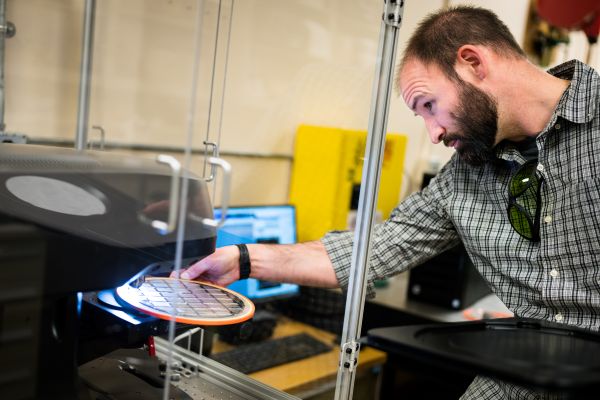
Sandia National Laboratories’ Quinn Looker inspects sensors
used in the ultrafast X-ray imaging camera.
Photo by Craig Fritz
In addition to the national labs, AHS provides services to fusion startups. “The fusion startups are a great first customer because they're doing the exact same type of work that the national labs are doing,” said Sanchez. “So, it's a very natural transition take this technology and adopt it there.”
Claus and Sanchez are taking their time regarding company growth. “We made that choice to bootstrap and self-fund so that we can control the direction of our company,” said Sanchez. “And so, it's taken us a little bit of time to get enough internal funds to develop our own product.” Currently, there are four people working at AHS; they expect to bring on another engineer from Sandia soon.
“There's an incredible amount of IP that's generated at the labs that are an amazing resource for commercial growth,” said Kistin. “Our job is to help facilitate those transitions from the lab to market. Folks like Liam and Marcos take what they've developed for a very specific use case and then build on it for economic competitiveness for the country.”