
For the civic leaders of Osceola County, the Great Recession of 2008 made clear that they could not base their economy so heavily on travel and tourism. By the time COVID-19 hit in 2020, they knew the steps they had taken to diversify their economy were the right ones. When the Build Back Better Regional Challenge (BBBRC) opportunity arose in 2021, the county and its partners were well-positioned to operationalize the benefits the grant presented to the region and create a trained workforce for a recently attracted semiconductor industry.
How did Osceola County get here? There are potential approaches to emulate by more areas of the county dependent on low-wage sectors like tourism or, for that matter, extraction-focused regions subject to “boom and bust.”
After the Great Recession, the Osceola County Board of County Commissioners approved a strategic plan that prioritized diversifying their economy, drawing on a cluster analysis that indicated advanced manufacturing was likely to do well as a priority focus. Around 2015, the county issued debt to build a fabrication facility (fab) in NeoCity, a green-field tech district it was building on 500 acres of former farmland.
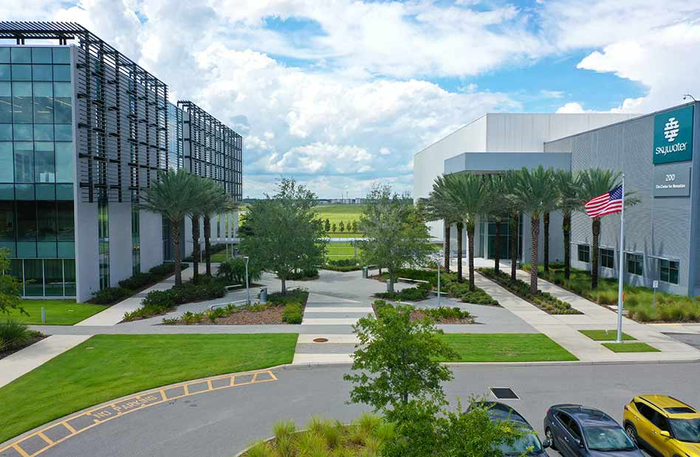
NeoCity Campus
Soon after, the School District of Osceola County built NeoCity Academy, a STEM high school, which opened on the NeoCity campus in 2019. The school offers STEM education and internships with SkyWater and other organizations. It also has its own mock gowning room. “The students graduate with a deep level understanding of the semiconductor industry that is unheard of for most high school students,” said Amanda Clavijo, assistant county manager of Osceola County.
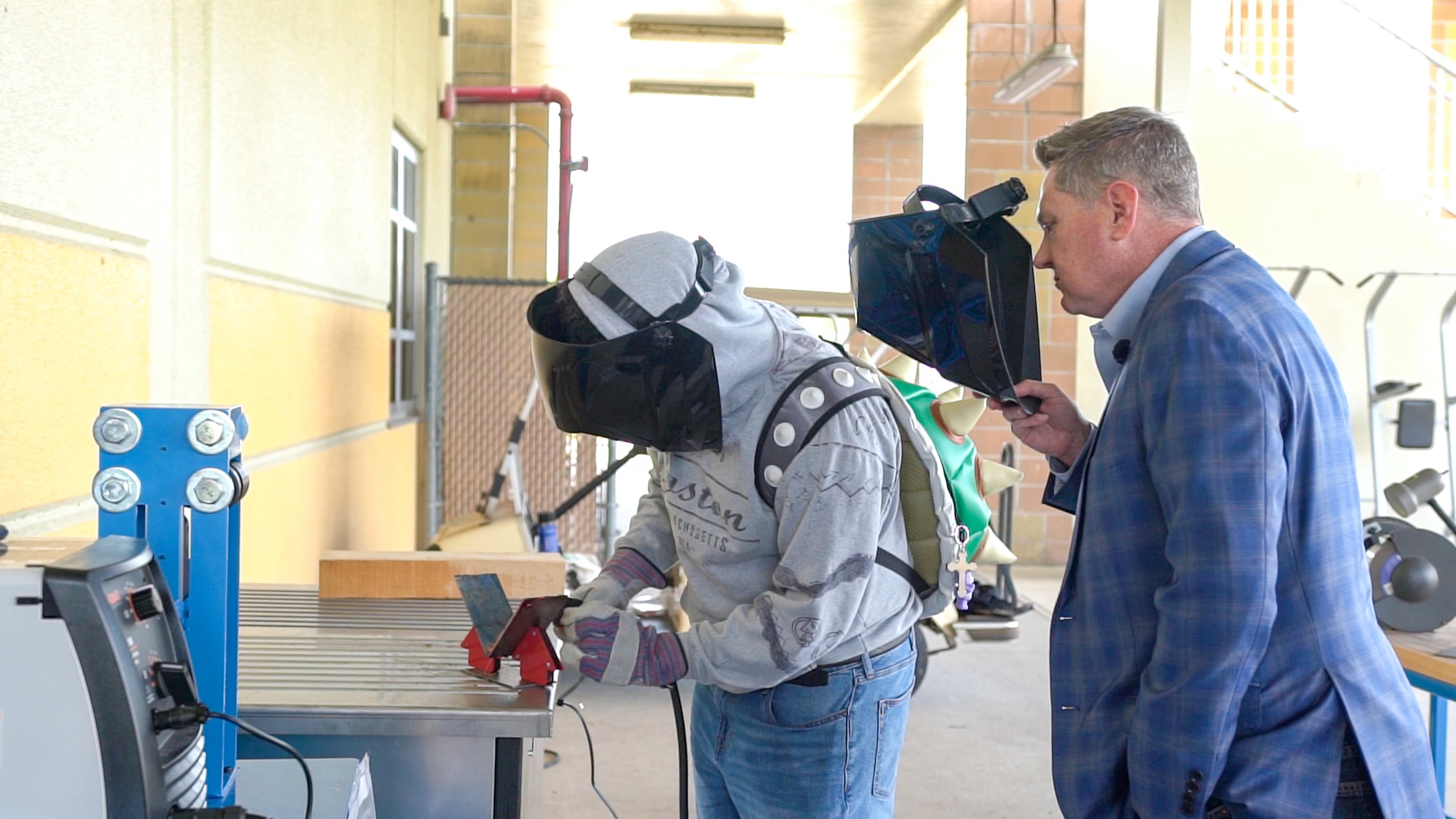
Liberty High School student and Osceola County Commission Chair Brandon Arrington in Liberty's new Career and Technical Education Manufacturing Lab, which was paid for by Osceola County Board of County Commissioners
In 2020, the workforce in Osceola County was acutely challenged by the COVID-19 pandemic: its unemployment rate, at 32%, was the third highest in the nation. “Tourism—our number one employment opportunity—completely shut down,” said Clavijo. At the onset of the pandemic, the county looked for a new operator of the fab after UCF decided to pull back, inviting semiconductor manufacturing companies to relocate to NeoCity and partner with Osceola County.SkyWater Technology was selected and became the operator of the Center for Neovation, the county-owned fabrication facility.
In September 2022, the Economic Development Administration (EDA) awarded the Osceola County Board of County Commissioners and coalition partners under the BBBRC a total of $50.8 million to accelerate the growth of the specialized semiconductor cluster at NeoCity. Clavijo noted,
"The Board of County Commissioners timed it right. Osceola County started investing in semiconductors before the federal government made the initiative to onshore advanced packaging and semiconductors. The Board of County Commissioners already had a foundation, and it helped us take it to the next level. The site already had a lot of regional investment. Build Back Better captured exactly what our challenges were and what we needed to help us rebound from the pandemic.”
Bringing in semiconductor manufacturing companies necessitated training workers for the industry, and SkyWater’s contractual relationship with Osceola County requires the company to create higher-paying jobs for Osceola County residents. SkyWater created an internship program for the students at NeoCity Academy, Valencia College, and Florida's state colleges and universities, an initiative that is still ongoing. SkyWater has hired six previous interns as full-time process engineers and equipment engineers since the start of the program.
At the time the BBBRC grant was awarded, SkyWater had 60 employees, having grown from six when it opened at the NeoCity location. The grant enabled SkyWater to expand its operations by funding 17 new tools and completing the facilitation of the cleanroom. “If it were not for that grant, we wouldn't have been able to procure those kinds of tools,” said Ben Larry, formerly director of human resources at SkyWater.
To ensure a steady stream of interns prepared to work in the semiconductor industry, Skywater partnered with Valencia College to create an associate's degree program in semiconductor engineering and to enhance its robotics and mechatronics (a blend of computing and engineering) accelerated skills training programs. "SkyWater then focused on hiring students in those programs as interns," said Larry. "SkyWater would interview and hire those students who finish those certification programs primarily as fab operations technicians. SkyWater’s commitment has been to be able to offer higher paying jobs to Osceola County residents.”
Valencia created a bachelor’s degree in semiconductors that complements their associate’s degree in semiconductor engineering technology. UCF's DirectConnect to UCF program allows Valencia College associate's degree graduates to gain automatic admission into UCF’s School of Engineering’s semiconductor degree program.
Florida state policy allows curricula created at any state college to be made available to all state colleges, enabling these semiconductor programs to be offered throughout the state. The Semiconductor Technology and Nanomanufacturing associate in science degree created at Valencia College is now offered at Miami Dade College.
Osceola County built a semiconductor workforce where none had existed before. A significant amount of groundwork, including community outreach, was needed to create a critical mass of workers in the newly introduced industry. “Osceola County gave a (BBBRC) sub-award to the Osceola Chamber," said Clavijo. “One of their main tasks in the Build Back Better grant for governance and outreach is getting the information out to the community, to the students, to their parents on all these programs so that we build excitement around the semiconductor industry.”
“SkyWater, our site partners, and county staff do a lot of participation in activities,” Clavijo added. “They do outreach to K through 12. They go to events to help excite kids about the semiconductor industry, to help give the information about the different programs and the jobs to get them interested in going to Valencia or UCF.”
The Florida Semiconductor Institute (FSI), where Larry now works, partnered with SkyWater to host the first All Interns Poster Board Session to showcase the student’s projects and assignments to other students, leaders from industry partners, community leaders, and education leaders. “The Poster Board Session gave the students an opportunity to network with leaders from other industry partners,” said Larry. “It is a way for communities and industry partners to understand the interns are not performing busy work…they are getting hands-on, real-life experience working in a clean room environment within a semiconductor or semiconductor-related manufacturing company;” said Larry.
There is also a concerted effort to speak with prospective employees. “I make in-person visits to college campuses for career fairs. I also attend the FSI Industry Mixers to interact with as many students as possible, so students know who I am and what the internship program is about,” said Larry, who is now the assistant director of workforce integration at The Florida Semiconductor Institute.
Since the beginning of the internship program, SkyWater has always hired at least one of their interns each year, helping to increase the size of their full-time workforce. The company has about 140 employees and projects having approximately 300 by the end of 2027. "None of this would have been made possible without the BBBRC and the DoW contract,” said Larry. "SkyWater wouldn't be on this massive expansion and the rate of hiring if it were not for the BBBRC and other grants that the county facilitated.”
Another company, Elspes, will be breaking ground, likely in 2028. They plan to hire approximately 600 employees over the next few years.
“For Osceola County, the entire project was for building the workforce,” said Clavijo. “The Board of County Commissioners was trying to create the opportunities that would bring the jobs to Osceola County and to our region. And the board felt advanced manufacturing would get us there and be sustainable for our region.”
“If not for Build Back Better, I don't know where our site would be," said Clavijo. "It did two things. It gave us momentum, and it was the first stamp of approval from the federal government that said, 'you guys are doing the right thing.”