
Our future prosperity will always require innovation. What is TBED?
Innovation requires an openness to the possibility of doing things better.
Entrepreneurship is the urgent willingness to try.
~ Mark Skinner, SSTI President & CEO
For America's global competitiveness, our federal, state and local prosperity policies should increase the likelihood of success for more high-impact enterprises capitalizing on scientific and technological innovation. Technology-based Economic Development (TBED) is the field of policy and practice addressing this critical need. TBED is the bundle of public-private policies and programs that use scientific discovery, technology development, and creativity to move innovation through the formal and informal networks, organizations, institutions, and community that collectively comprise a regional innovation system.
TBED differs from conventional economic development by encouraging local growth based on innovation that, if the regional innovation system is working smoothly, can sustain economic opportunities for the region well beyond traditional strategies focused heavily on business/industrial recruitment and retention. TBED places stronger emphasis on creating new opportunities by nurturing the region’s innovation capacity or system, rather than recruiting companies from other regions.
TBED 101: Technology readiness and market funding gaps point to need for TBED support
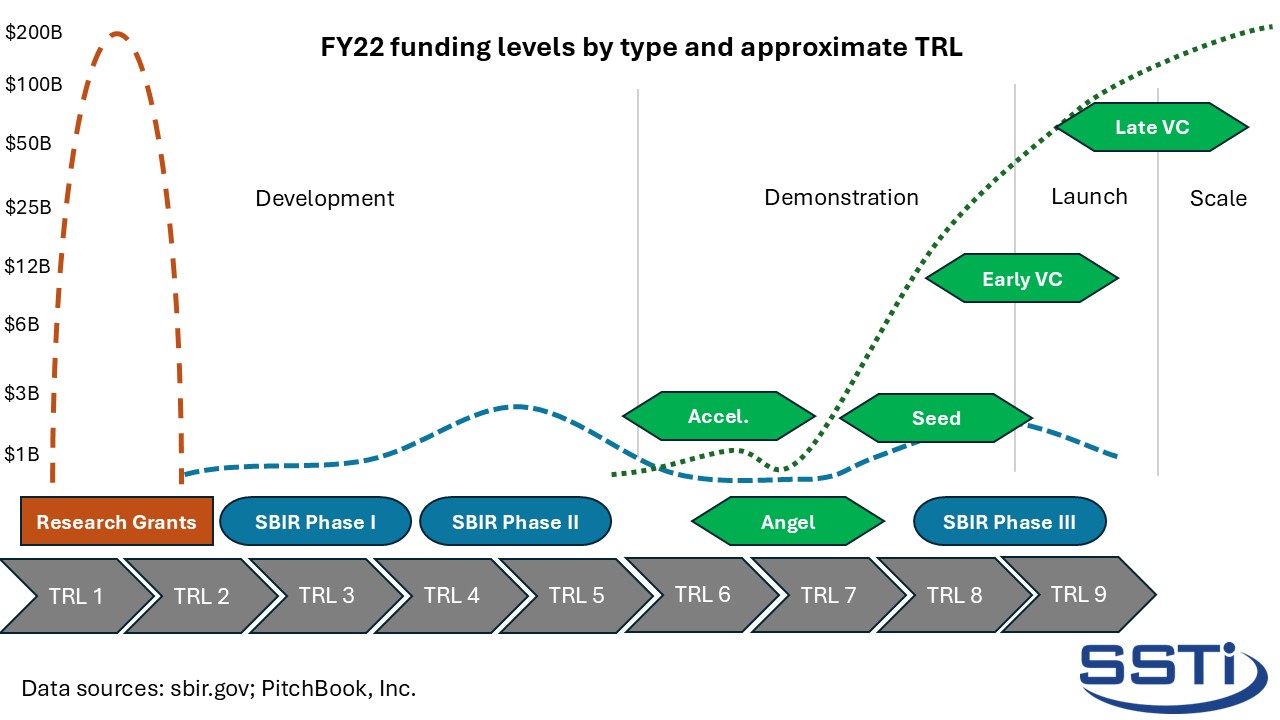
Understanding and using Technology-Readiness Levels to guide innovation finance strategies
Early-stage companies often have unproven technologies, products, business models, and teams. However, technology development and investor interests are more likely to align when the technological innovation can create value at a level of risk acceptable to the investor. So, how do we understand how well developed a company needs to be for investors to be comfortable? Companies that have entered the market can often point to customer growth and revenue figures. But what framework can we use to communicate a company’s technological progress and broadly assess the future needs and risks of one opportunity against others?
Why focus on state & regional innovation systems?
Regional innovation systems across the country vary greatly in structure, effectiveness and efficiency at moving innovation into practice or commercial production. The overall success of a regional innovation system depends upon the quality of the individual assets within the particular region and the linkages between these elements locally and globally.
Sometimes regions require a little support.
Regional innovation systems often ignore local political boundaries. Instead, the constituent elements in an effective regional innovation system draw on participation from all aspects of a regional community (private, government, education, research, philanthropic, financial, civic, etc.). Innovation economies emerge, they are not made. Recognizing this distinction is a defining quality of using a systems approach to support innovation and regional prosperity.
Vibrant innovation economies require collaboration across public, private and nonprofit partners.
The specific character, culture and vibrancy of a regional economy emerges from the interplay of many dynamic, complex adaptive systems. Disruptions are a part of the process.
A well-designed regional innovation support system is but one set of actors to restore and sustain prosperity.
Bottom line: the effectiveness, efficiency and resilience of most regional innovation systems can be improved through public policy, program investments, and other strategic interventions. SSTI is here to help.

VC investment trends: Shrinking, growing, or just moving?
While repeatedly writing about VC investment trends over the past year can feel a little like the movie Groundhog Day, like the film, the story is more nuanced than it would first appear. Sure, the overall message of high-dollar deals driving headlines and boosting investment levels to record heights persists, but there are some emerging trends deeper in the data that bear exploring to see if there are issues or opportunities that impact how TBED investors allocate resources going forward.
Using PitchBook data to look at total deals and dollars in rounds under $100 million, we see that both measures are down from Q1 and continue a general slide over the past year (Figure 1). Total Q2 dollars are down approximately $2 billion from the prior quarter and have returned to 2024 levels at $21.5 billion. Deal count is down by nearly 600 deals to a new low of 1,356 transactions. Importantly, the Q1 numbers are higher than initially reported as more data has come in, though the expected Q1 peak in deal volume is still relatively low.