Tech Talkin' Govs, Part II
The second installment of SSTI’s Tech Talkin’ Govs’ series includes excerpts from speeches delivered in Colorado, Virginia and West Virginia. Our first installment was in the Jan 13 Digest.

The second installment of SSTI’s Tech Talkin’ Govs’ series includes excerpts from speeches delivered in Colorado, Virginia and West Virginia. Our first installment was in the Jan 13 Digest.
Gov. Mark Parkinson last week unveiled his FY11 budget proposal, which includes $5.9 million from the Economic Development Initiatives Fund (EDIF) for the Kansas Technology Enterprise Corporation (KTEC), down $1.8 million from the FY10 governor’s estimate of $7.75 million. Many of the governor’s budget recommendations, including funding for KTEC and university research initiatives, may hinge on a tax increase proposal, however.
Describing the nation’s innovation system as broken, U.S. Secretary of Commerce Gary Locke yesterday said the Department of Commerce will be “working hard to find solutions” that move more federally funded R&D into the commercial market.
“Even in areas where we are allocating enough funding for R&D, we’re not doing a good enough job getting these ideas into the marketplace, particularly through entrepreneurs.
Gov. Sonny Perdue last week outlined an $18.2 billion budget for FY11 that reduces spending across several state agencies, including a $9.6 million reduction for R&D activities through the Research Consortium. The governor’s budget also would eliminate two science, technology, engineering and mathematics (STEM) programs within the Department of Education.
Enterprise Florida released its latest five-year strategic plan for the state, calling for increased investment in STEM education, university research, commercialization assistance and early-stage capital access programs. Florida must diversify its economy and strengthen its high-tech industries in order to reduce the state’s reliance on population-based growth, according to the report. Enterprise Florida also endorses a cluster-based strategy to promote high-tech industries based on their relative levels of development in the state.
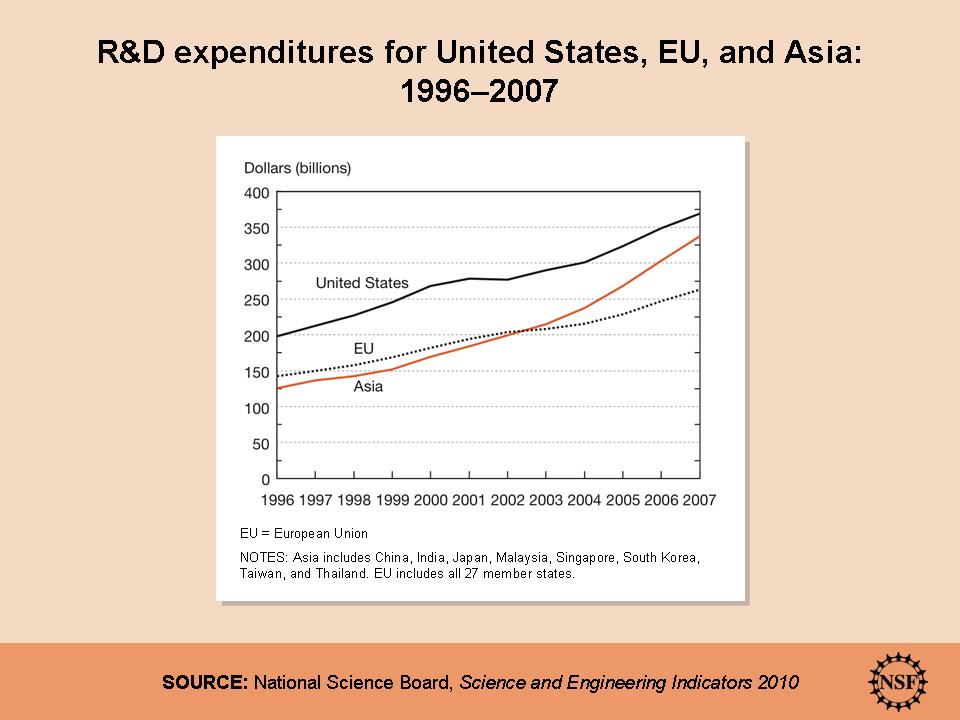
Current trends presented in the 2010 edition of the National Science Board’s biennial Science & Engineering Indicators suggest as early as the 2012 edition, the U.S. will no longer leads the world for a key indicator: total R&D expenditures – unless corrective action is taken.
Entering its tenth year covering governors’ State of the State, Budget and Inaugural Addresses, SSTI’s Tech Talkin’ Govs series highlights new and expanded TBED proposals from across the nation. The first edition includes excerpts from speeches delivered in the following states:
Arizona
Gov. Janice Brewer, State of the State Address, Jan. 11, 2010
The Baton Rouge Area Chamber (BRAC) has released the second and final component of its strategy advocating the need to advance a tech-based economy throughout Louisiana. The white paper focuses on the topics of entrepreneurship, workforce development, risk capital, and coordinating TBED efforts at the state level. For example, BRAC calls for all returns from state funds invested in venture capital firms to be reinvested, for regional angel networks to be supported, and for the state’s angel investor tax credit to be reinstated.
Providing strong evidence for how public investments in research and TBED pay off even on a short time horizon, a recent impact analysis calculated the total impact from the first $19.9 million North Dakota spent over the past four years for the establishment of 20 Centers of Excellence across the state. The analysts from North Dakota State University reported a combined cumulative impact of $329.5 million for the 30 months ending June 2009. The total includes both direct reported results and estimates for indirect impacts.
U.S. venture capital fundraising and venture-backed exits improved marginally in the fourth quarter of 2009, despite having a very slow year overall, according to the National Venture Capital Association (NVCA). Venture fundraising increased to $3.8 billion in the last quarter, an 82.6 percent increase over the previous quarter but still far short of fundraising levels in recent years. While investors expect activity to grow in 2010, most predict that the industry will remain smaller than its scale in the 1990s and 2000s, with fewer firms and increasing focus on late-stage deals.
JobsOhio, the private, nonprofit corporation authorized to replace Ohio's economic development system, would administer state funded programs and services that have a direct, high-impact on job creation such as business loans, infrastructure grants and deal-closing funds, according to a report to the Ohio General Assembly. At the same time, a newly named Ohio Development Services Agency (ODSA) would focus on programs with a more indirect impact on job creation, including federally funded programs and services geared toward communities and individuals.
Commissioner of the Tennessee Department of Economic and Community Development, Bill Hagerty announced the state will commit up to $2.25 million for the Jobs4TN Regional Entrepreneurial Accelerators program. The grants will award up to $250,000 to a regional entrepreneurial accelerator in each of the state's nine economic development regions.
The Obama Administration has announced that it is extending the comment period for public input on the Economic Development Administration's (EDA) Strong Cities, Strong Communities Visioning Challenge (see the July 13, 2011 and
Governors in the Southern states were presented with findings from a new report on the growing gap in middle-skill jobs and urged to adopt a three-part policy framework for reversing the trend during the Southern Governors' Association annual meeting last week in Asheville, NC. The report found that middle-skill jobs account for 51 percent of the region's jobs today, but only about 43 percent of the region's workers are currently trained at this level.
Educational attainment rates in the U.S. rose in both 2007 and 2008, after falling in 2005 and 2006, according to data from the U.S. Census Bureau's American Community Survey. Despite the mid-decade dip, the overall trend over the past few decades has been toward higher rates of attainment at the high school, Bachelor's and advanced degree levels. As of 2008, about 85 percent of the U.S. population had completed high school, up from 80.4 percent in 2000 and 75.2 in 1990. About 27.7 percent of U.S.
The Rhode Island Science and Technology Advisory Council seeks to hire a program manager to oversee activities of the RI Research Alliance.
During the upcoming legislative session in Missouri, lawmakers will consider a proposal by Gov. Jay Nixon to create a funding source aimed at attracting top scientists, commercializing research, recruiting and building science infrastructure, and creating capital programs for early-stage technology companies. The Missouri Science and Reinvestment Act (MOSIRA) would dedicate an annual portion of new tax revenues generated by biotechnology companies to a newly-created state fund administered by the Missouri Technology Corporation.
Gov. Gary Herbert unveiled last month an $11.3 billion spending plan for FY11 that maintains level funding for higher education and slightly reduces funding for the Utah Science Technology and Research initiative (USTAR). The governor's FY11 budget plan addresses a $693 million shortfall, which is spread across FY10-11 and anticipates $34 million in state revenue growth during the next year. Read more ...
Arizona's state, regional and university leaders already have made efforts to stimulate elements of a high-tech economy; however, missing are key fundamentals necessary for the state to compete on a national level, finds a report on Arizona's tech economy.
Government intervention in the venture capital industry might be the key to boosting the performance of venture-backed businesses, according to a recent report published by the World Economic Forum. A review of 28,800 venture-backed firms from 126 countries found that enterprises receiving moderate levels of government venture capital support outperformed other firms in terms of value creation and patent creation. Read more ...
There is no simple answer to a frequently asked question that SSTI receives: what should we expect to be a good return on public investment in research? A new working paper available from the National Bureau of Economic Research helps clarify the range of possible answers, though, and strongly suggests the investment is worthwhile.